
If you’re a parent, you already know: advice is everywhere. A quick scroll tells us what our kids should eat, how many minutes they should read, and how to respond to every possible tantrum. It feels like there’s an instruction manual for everything—except how to survive the weight of it all. This is where Self-Compassion for Parents becomes essential—not as a luxury, but as a powerful tool for staying grounded, whole, and present.
We often hear about the importance of patience, boundaries, empathy, and discipline. But what about us? Who teaches parents how to stay whole, gentle, and grounded in the process?
This is where self-compassion enters, as a tool that allows us to show up for our children without burning out.
In this article, we’ll explore:
Why perfectionism has become the modern parenting trap
What self-compassion really means (and what it doesn’t)
How to practice self-compassion in daily parenting moments
The ripple effect: why caring for yourself builds trust and resilience in your kids
Letting Go of Perfection in Parenting
There’s a familiar story in parenting culture: the myth of the perfect parent. We feel that we need to be the ideal parent, but to be everything for our children — perfectly — in every aspect of their lives. Cook perfectly. Play perfectly. Educate perfectly. Regulate perfectly.
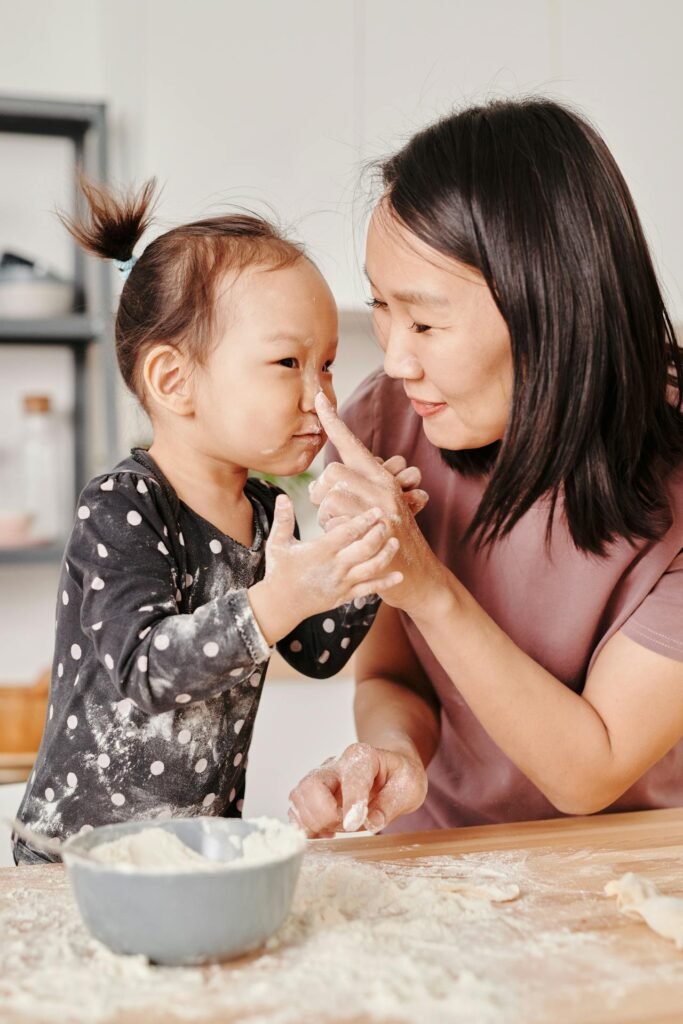
But here’s the thing: today, it’s not just about being “perfect.” It’s about being everything.
We’re told to be our child’s teacher, nutritionist, therapist, emotional coach, playmate, and planner—all in one.
We’re expected to anticipate every need, while also staying calm, creative, and endlessly present.
And the worst part? We’re asked to keep this up while relying mostly on ourselves, with less community support than past generations had.
Meanwhile, the more information becomes accessible, the more it feels like a list of requirements: one more thing we “should” be doing better.
This relentless pressure feeds parenting stress and parental burnout, especially when most of the time, we’re expected to carry it all alone. More information is available than ever, yet with it comes more expectations and fewer support systems.
This is exactly why Self-Compassion for Parents matters: it offers a way out of the performance trap and back into connection.
The Next Step: Self-Forgiveness
Once we loosen our grip on perfection, the next step is often harder: forgiveness.
Guilt is heavy in parenthood. We replay our mistakes, harsh words, or missed moments as if they define us. But guilt only holds power when we cling to the illusion that we should never make mistakes.
Self-forgiveness is a form of self-compassion. It’s choosing to say: “I am human. I make mistakes. And I still deserve love — from myself and my children.” When we release guilt, we create space for growth, humility, and deeper trust in our relationships.
What Self-Compassion for Parents Really Is
When people hear “self-compassion,” many think it means letting themselves off the hook, lowering standards, or practicing self-care rituals like bubble baths. While rest has its place, true self-compassion goes much deeper.
Compassion means “to suffer together.” It’s an emotion that arises when we see someone else’s pain and feel motivated to ease it. It’s more than empathy (which notices suffering) and more than altruism (which acts on it). It is both awareness and care.

So what happens when we turn that inward?
We acknowledge our pain, fatigue, guilt, or stress.
We resist the urge to dismiss or criticize ourselves for struggling.
We respond to our own suffering with care, just as we would to a child or loved one.
I like to think of it as an invisible armor: a value that protects us from being swallowed whole by parenting’s demands. Instead of tearing ourselves apart with “not enough,” self-compassion says:
“I am human. I am limited. And I am worthy of care, even here.”
This is not indulgence. It’s survival and more than that, it’s the foundation of healthy parenting.
How Self-Compassion Translates to Parenting
I remember a time when I would rush from task to task without taking a breath. My kids, sensing my stretched energy, became more demanding. They asked for more and more, yet seemed never satisfied.
It hurt. I wanted them to trust me, to feel safe with me. Instead, many conversations spiraled into negotiations or contradictions. I was teaching them, without meaning to, that I was always available for others but rarely present for myself.
Things began to change when I started practicing self-compassion. I told my children: “You cannot love others if you do not love yourself.” Slowly, I began living up to my advice.
Setting boundaries kindly became part of our daily rhythm. Saying: “Mommy needs a break” or “I need some quiet right now” was not rejection but modeling honesty. My children learned that parents have needs too — and that honoring those needs helps the whole family thrive.
Parenting with Self-Compassion: Everyday Tools for Tough Moments
So how does all of this play out in daily life? Here are a few ways self-compassion becomes a practical parenting tool:

It quiets the inner critic.
Instead of berating yourself for yelling, you pause and acknowledge: “I lost it because I’m exhausted. I need rest.” This interrupts the cycle of guilt → shame → reactivity.
It models healthy boundaries.
By saying, “I need space,” you teach your children that needs are normal, and boundaries are part of love.
It lowers conflict.
When we treat ourselves with compassion, we have more patience left for our kids. The atmosphere softens.
It builds emotional resilience in children.
Children who see their parents treat themselves with kindness learn to internalize the same voice for themselves.
In other words, the way you treat yourself shapes the way your children learn to treat themselves.
Quick and Gentle Self-Compassion Habits for Busy Parents
Self-compassion doesn’t have to be another task on your endless list. It’s woven into the small moments. Here are practices you can begin right now:
Pause before reacting
Take one deep breath when your child pushes your limits. This small pause is a gentle parenting tool that shifts reactivity into calm.

Speak kindly to yourself
The way we talk to ourselves shapes our mindset and, eventually, the course of our lives. Instead of telling yourself “I should be more patient,” try: “I choose patience.” Swap “I should” with “I choose to” — and watch how your inner monologue becomes a source of strength instead of shame.
Set a micro-boundary
Tell your kids: “I need five quiet minutes.” Far from being selfish, this models self-care and teaches them how to respect others’ limits. It’s one of the most powerful ways of raising resilient kids.
Release the myth of perfect
Choose connection over perfection. Children don’t need flawless parents; they need real ones. Messy but present always beats perfect but distant.
Practice self-forgiveness daily
At the end of the day, instead of replaying mistakes, whisper to yourself: “I did the best I could with what I had today. Tomorrow is a new chance.”
Self-Compassion for Parents: Your Most Powerful Parenting Tool
Patience can run out. Discipline strategies can change. Parenting theories come and go. But self-compassion? That is a renewable source of strength.
It allows you to parent from a place of wholeness rather than depletion. It shields you from the endless comparisons and “shoulds” of modern parenting. And it shows your children, through lived example, that worth and love are not earned by perfection, but carried within them.
When parents practice self-compassion, children don’t just get calmer households. They inherit a model of resilience, kindness, and self-respect they’ll carry into their own lives.
And maybe that’s the truest definition of “good parenting.”
Final Reflection
We often wait for someone else to give us permission to rest, to pause, to breathe. But the truth is—you don’t need permission. You need yourself. You are the very first person you can count on, and your well-being sets the tone for your entire family.
Self-compassion for parents isn’t selfish. It’s the invisible thread that holds everything together. When you practice it, your children don’t just hear your words, they witness your example. They learn that it’s human to have limits, that it’s okay to say no, and that caring for yourself is part of caring for others.

And it can begin right now. Begin today with one simple, intentional act of gentle parenting toward yourself:
Whisper a kind word to yourself when guilt rises.
Step outside for five minutes of fresh air.
Place a hand over your heart and breathe.
Tell your kids, “Mommy needs a little space,” and show them that boundaries are healthy.
These small choices ripple forward. They become the model to raise resilient kids, proof that compassion begins at home, with the way we treat ourselves.
So don’t wait. Start with one act of self-compassion today—and let it be the beginning of a gentler, truer way of parenting.